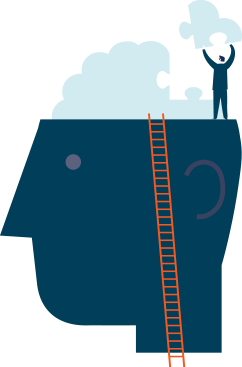
Things to think about and ways to make changes
People have been using tobacco, alcohol, cannabis and other drugs throughout history.
Like all things involving humans, substance use is complex (not just "good" or "bad"), and has the potential to both help and harm. Using substances affects each of us differently. Do you ever think about your relationship with substances? Do you ever question your attitudes and actions related to substances? If so, read on. This booklet was developed to help you better understand your relationship with the substances you use and change that relationship should you wish to do so.
No one has the same combination of genetics, life experiences, influences, and personality traits that you do. Your relationship with substances is equally, just yours.
You are unique
You are the only you there is in this world. You may share some qualities with your sister or friend or co-worker. Some of your traits may be linked to your family, where you were born and when you grew up. No one has the same combination of genetics, life experiences, influences, and personality traits that you do. Your relationship with substances is equally, just yours. Though you may use the same substance as your spouse, cousin or colleague, how and why you use that substance may be very different. The effects you experience may be very different too. For example, you may feel relaxed after one drink, while your brother starts feeling angry. Your friends might feel more light-hearted and alive after a few puffs of cannabis while you feel paranoid and anxious.
A substance may also affect you differently after a long period of regular use. For instance, you probably know people who have smoked cigarettes and used alcohol their entire lives and have yet to experience a related health problem. They may have avoided relationship, financial, and legal problems too. You likely also know people whose illness or death was directly linked to their use of tobacco or alcohol. It is quite possible that their smoking and drinking pattern also affected their marriage, education, career and/or finances. You are unique and your relationship with substances is unique. Even the way you process and use the information and exercises in this booklet is unique!
Getting to know yourself a little more
One of the opportunities each of us should have in life is to reach toward our full potential for health and happiness. You can help yourself and those close to you reach toward their potential as well. Managing your life—your education, career, family obligations, and so on—is an ongoing process. Your needs and wants change over time, as do you. You may start seeing that your current attitudes and behaviours around substances may have to change to do or achieve what you want in life. This begins with knowing yourself better: your personality, your values, what stresses you out, what makes you smile, and what makes you run for cover! One way to do this is to consider your personal ups and downs, the challenges and triumphs along the road of life.

To help you find out where you are now try writing down your answers to the following:

-
On a scale of 1-10 how is your life right now?
-
What is going well?
-
What is not going well?
-
What are some things about yourself you are proud of? (This could be achievements at school, work, with your family, friends, or contributions you have made to your community.)
-
What qualities led you to these successes? (For example, intelligence, a strong work ethic, compassion, or honesty.)
-
What are some things in your life that you don't like or are not so proud of? (It could be something you did or didn't do for yourself, or another person or something you did that didn't turn out the way you hoped.)
-
Why do you think those things happened? Did substance use play a role, and if so, how big a one? Do you think things might have turned out differently if drugs were not involved? (Perhaps you had a difficult situation at home, school, or work. Were there issues between you and your friends, parents or spouse?
When we feel good about how our life is going, it is often easier to make decisions that support our health and well-being. If we don't feel so good about our life, we can make decisions that might be less helpful to us. These questions can help you take a look at a number of things that you can change to help you feel better about yourself and your life, including your use of substances.
You are not alone
Many people question their use of tobacco, alcohol and other drugs. Many are also considering ways to make changes to the way they currently use substances. Some people are able to overcome their problems on their own, or with self-help materials. Most of us need support from other people—family members, friends, counsellors, medical professionals, people who share the same faith, or people dealing with substance use issues. No matter which way you choose to explore your relationship with substances—on your own, with help, or with lots of help—just know that you’re not alone.
You can explore your connections (social circle) by writing down:
-
Who are you close to? (might be family members, friends, and people you share things with)
-
Where do you belong? (such as clubs, groups and organizations you are part of)
-
Who would you talk to, or where would you go, if you needed help with a problem? (This might include your school, church, a counsellor or family friend)
Tip: Are you having trouble answering these questions? Check out the Tips and Tools section at the end of this booklet for ideas on enlarging your social circle.
People use drugs
Today, as in the past, drug use is a part of almost all societies. People have used caffeine, tobacco, alcohol, cannabis, and other drugs—often to help them manage their daily lives. For example, many of us use drugs to celebrate successes and help deal with grief and sadness. We use drugs to mark rites of passage such as graduation from school or getting married, and to pursue spiritual growth. We use them to get going and to unwind. In other words, drugs are still used as aids to daily life. Many of us use caffeine to perk up for work, or tobacco, alcohol and cannabis to help relax during or after a stressful day. We also use these drugs to help celebrate the New Year or cheer on our favourite sports team. Some of us use substances to cope with boredom and frustration, i.e., a form of entertainment.
Virtually all societies in some way celebrate, depend on, profit from, enjoy, and suffer from the use of drugs, though the types of drugs used may be very different from culture to culture. During the last century, there was an increase in the growth, manufacture and trade of mind-altering (psychoactive) substances. Some substances are ancient and others new. Some have been developed from medications made initially for treating pain, sleep or mental health concerns such as heroin, barbiturates and benzodiazepines. Others have been manufactured for recreational use (e.g., ecstasy). Still others—notably cannabis—are made from plants or seeds that have been cultivated and traded to new and much larger markets.
The Most Common Reasons People Use Substances
To feel good
Stimulants may lead to feelings of power, self-confidence and increased energy. Depressants tend to provide feelings of relaxation and satisfaction.
To feel better
People may use substances to reduce social anxiety or stress when building connections with others or to reduce symptoms associated with trauma or depression.
To do better
The increasing pressure to improve performance leads many people to use chemicals to "get going" or "keep going" or "make it to the next level."
To explore
for novelty and a higher tolerance for risk. These people may use drugs to discover new experiences, feelings or insights.
Many people use substances without experiencing difficulties.
Some people, depending for example on their health, genetics, family history and current life issues, may run into problems when using substances. You may have a problem with substances at one time in your life and not at another time. The information and exercises below might help you to determine if you are having a problem with your substance use right now.
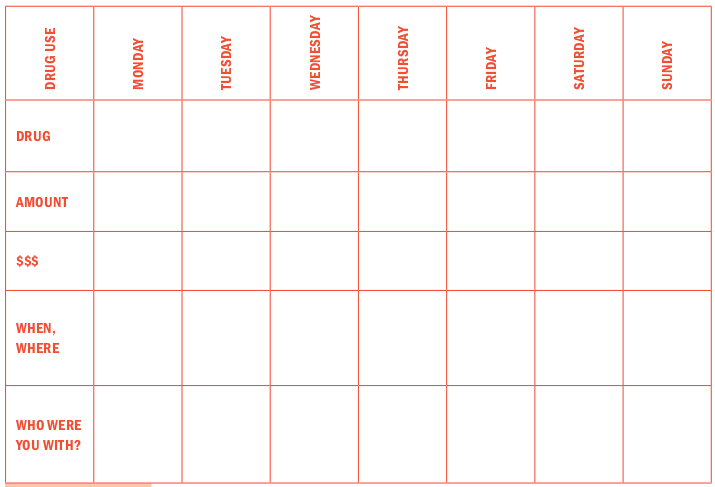
Follow up questions: What are your first thoughts when you look at the table when it is filled out? Are there any surprises? If so, what are they? If not, why do you think that might be?
Drug categories
Drugs are often categorized as legal versus illegal, or soft versus hard. These groupings can be misleading since they don't necessarily reflect the type or level of risk associated with using a particular drug. A more useful classification involves impact on the brain and spinal cord, also known as the central nervous system (CNS):
-
Depressants decrease activity in the CNS (e.g., decrease heart rate and breathing). Examples include alcohol and heroin.
-
Stimulants increase activity in the CNS (e.g., increase heart rate and breathing). Caffeine, tobacco, amphetamines and cocaine are examples of stimulants.
-
Hallucinogens affect the CNS by causing changes in perception, what we see, hear, taste, smell, or touch. Magic mushrooms and LSD are examples of hallucinogens.
Note: Some drugs, such as cannabis, are not easily classified because they fit into more than one category.
More on why some people have difficulties when using substances
For centuries, humans have been trying to explain why some people experience issues with substance use and others don't. At one time, it was widely believed that people with severe drug use struggles were possessed by evil spirits. Another popular theory suggested people with substance use problems choose in some way to have an issue, perhaps through a lack of will power. Some people still think this way. More recently, harmful substance use has been regarded by some as a disease that requires treatment and careful monitoring, similar to diabetes, heart disease, or cancer.
The disease model continues to be the foundation of Alcoholics Anonymous and other programs that see substance use as an illness of the heart best addressed by admitting your behaviours and surrendering to a higher power. Some people who formerly used drugs disagree with the disease model. In Being Human: Addiction as a catalyst, William Pryor writes:
Addiction is no more an illness than are grief, depression, lack of attention, homosexuality, single motherhood or genius, all of which psychiatry has regarded, at one time or another, as illnesses in need of surgical, electrical, pharmacological, committal and other drastic interventions...We take moodaltering substances to "treat" the human condition, the pain of being.
Author and physician Gabor Maté argues that using large amounts of drugs often with little thought, reflects a need to soothe the impacts of childhood trauma such as repressed anger, and a number of other "human" concerns that can result in a variety of illnesses. Others think differently. Alan Marlatt, among several researchers, lean toward a "learned behaviour" explanation for substance use. Marlatt would argue "addiction" is a habit that can be unlearned.
Some researchers claim substance use problems reflect a disconnection from the world that some people feel. According to Bruce Alexander, some of the fundamental ideas of our society, such as industrialization and the free-market economy, have created an environment that fosters challenging behaviour in all of us. In other words, we have created a world where substance use problems are understandable ways of coping with the world.
Perhaps the simplest approach is to recognize that human behaviour—including substance use—is as complex as human beings themselves. In this view, each individual's relationship with substance use is unique, and substance use concerns may be a reflection of a wide range of "life" factors, including genetics, lifestyle, culture, habit, environment, and so on.
Drugs have the potential to help and harm
When people use drugs, they are manipulating the pleasure and reward system in their brain to achieve some benefit, or at least a perceived benefit. Our brains are wired to associate life-sustaining activities—eating, sleeping, sex—with pleasure. Drugs tap into that wiring and modify our feelings of pleasure, as well as our movement, emotion, thinking and motivation. This intense response encourages repeated use of a drug. Unfortunately, repeated use of a drug, especially in high doses, can be associated with significant harm.
Some harms relate to using too much of a drug at one time, and tend to be immediate (e.g., injury or death as a result of being intoxicated (drunk) or high when driving or doing other activities that require concentration, balance and good judgment. Other harms relate to chronic conditions such as heart disease and cancer that may emerge from longer-term use. Harms vary depending on characteristics of the drug or the way it is used. For example, much of the chronic harm related to tobacco is not from the drug (nicotine) but from inhaling the chemicals in the smoke over a long time.
If the brain is repeatedly exposed to a drug, it may go through changes to restore balance. These changes may have other consequences. The brain may not respond as well to certain stimuli, so that natural sources of reward such as food and sex, may no longer provide any significant pleasure and the person begins to feel flat and depressed. As a result, they need to take drugs just to feel okay, and sometimes, they need to take larger and larger amounts. These changes within the brain can lead to problems with thinking, talking, and moving around. They can also lead to strong associations between certain things, feelings, and the drug experience. Exposure to those things and/or feelings can later trigger powerful cravings for the drug. When a person's drug use has gotten to this stage, it is often more difficult to make effective changes.
Sometimes it's hard to understand all the reasons why you use drugs, alcohol, or other substances.
It can help to write down the pros and cons (positive and negative things) for each. Try filling out the chart below to find out what continuing your current use pattern versus making some changes might look like.
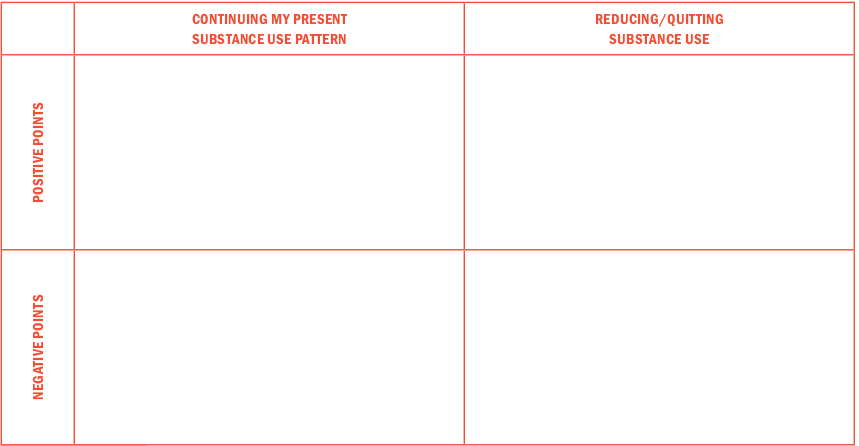
Follow up questions: What are some of the positive things that might happen if you make changes in your substance use pattern? What does a balance of positive and negative points say to you about your substance use pattern? Are you thinking you might want to make a change?
Experimental versus risky drug use

No one starts out smoking a pack of cigarettes a day. No one begins drinking a six-pack of beer one after the other. No one makes using a substance a habit right away. Despite stories in the media and drug education classes about people "getting hooked" on crack or crystal meth after using it just one time, most people use a drug many times before developing potentially harmful patterns of use. Yes, a person may like how a drug made them feel the first time they used it and then choose to use it again. That is not the same thing as being dependent or addicted. It is also important to remember that harm can result from a single use of a drug. This can happen for a variety of reasons. Your drug may contain another strong substance such as fentanyl that may lead to an overdose, the drug may be stronger than you think, or you may have a sensitivity to the drug that you may not be aware of if you have not tried it before.
Most of the time, people experiment with a substance just to see what it is like, or because they heard it could help them in some way. They don't generally want it to become an ongoing part of their life. Regular use can happen for a variety of environmental, social and individual reasons. For example, a person struggling to cope with a history of sexual abuse or bullying might use alcohol to cope with their feelings and end up using much more or much longer than they intended.
Similarly, a person with a health condition can develop an issue with prescription drugs, including painkillers and sleeping pills, after using them for a long period. Some people use substances e.g., caffeine or alcohol regularly because they like the taste or how it makes them feel, and do so without experiencing any problems.
Drug problems are like other problems
Some of us have a lot of trouble managing "normal" human activities—eating, sex, shopping, using the Internet—in a healthy way while others have no problem at all. Author Evelyn Lau makes this point painfully clear when she describes her eating problem in More and More:
I think of how many people would like to have more than one cookie out of the bag they bring home from the supermarket. Some of them do have several cookies, savouring them, then place the rest of the bag in the cupboard. Others have a harder time doing that; they eat too many cookies, half the package perhaps, then feel repentant and disgusted with themselves. But imagine ratcheting that urge up further. Imagine that you are unable to sleep because of the cookies in your cupboard, that you can't work or read or leave the house knowing the uneaten cookies are there. That a feeling of anxiety begins to build in you, a desperation and a kind of anger, until you break down and cram the cookies into your mouth several at a time, devouring them until you throw up. If, after you've thrown up, there are still some cookies left in the bag, you keep eating them, even though then you are sick of their taste and texture. If there are ten bags of cookies and no way that you can eat them all, you will have to bury the rest of them immediately at the bottom of the garbage pail—first crushing them and soaking them in water, say, to prevent your retrieving them later—in order to be rid of them. pencil
If you look past the substances you are using, is there something else in your life that is bothering you?
Try writing a little about that below.
Drugs play only a small part in the story of risk and harm
Some people struggling with drug use believe the drug itself is the main problem. They think, "If this drug didn't exist, I wouldn't have a drug problem!" There are several factors to consider when reflecting on how and why your substance use is becoming—or has already become—a concern. These are: why you use the drug, the content in which you use, personal factors and some things about the drug itself.
The reasons you use a drug powerfully influence your pattern of use and risk of harmful consequences. If you use a drug out of curiosity or other short-lived purpose, then you will tend to use only once as an experiment or once in a while. If you have a strong reason for using that lasts a long time (e.g., long-term sleep or mental health problem), then you might use more drugs over a longer period. Intense short-term use (e.g., to fit in, have fun or deal with temporary stress) can result in risky behaviour with a greater possibility for immediate harm (e.g., falls, fights, accidents, sexual assault). Similarly, the places, times and activities in which you use a substance strongly influence your pattern of use and the likelihood of experiencing harm.
Examples include:
-
unsupervised teen drinking
-
using substances in situations when strong emotions, such as anxiety or frustration are likely
-
using substances before or while driving, boating, hiking or any activity requiring concentration.
The overall context in which you use a drug is also significant. The cheaper and more available drugs are, the more likely they are to be used. What is accepted in a community also influences individual behaviour, as does the degree of connection to family, friends and the wider community. For example, places that offer alcohol-free social events encourage people to experience substance free ways to have fun.
In addition, a variety of personal factors such as physical or mental health may affect your chances of engaging in risky substance use. For example, if you experience anxiety or depression you may try to feel better by drinking alcohol. Using substances to cope with the trauma of physical, sexual or emotional abuse can contribute directly to risky substance use patterns. There is evidence that inherited factors along with personality or temperament may also impact substance use patterns. For example, tendencies towards sensation seeking increase a person's risk of harm from substance use.
Finally, certain factors about the drugs influence the risk of harm. All psychoactive substances, whether legal or not, have the potential to cause harm. The key factors in determining risk and harm include the amount used, the frequency of use, the purity of the drug, the mode of use (e.g., smoking, snorting or injecting), and the drug's chemical properties. Alcohol, heroin and other depressants, for example, have elevated risks related to overdose, whereas heavy use of some stimulants can lead to psychotic behaviour. Likewise, injecting concentrated forms of cocaine carries much more risk than chewing coca leaves, even though the same drug is involved. Not too much, not too often, and in safe circumstances is one way to think about your substance use that can help you reduce the risks and potential harms inherent in using psychoactive drugs.
Change is sometimes necessary
Most of us can and do use substances with minimal risk. Sometimes we get distracted or lose our way and start using more, and more often, than makes sense. As a general rule, when your drug use starts to cause problems in your relationships, or begins to negatively affect your work, finances or health, it's probably time to think about making some changes. It is not always easy to change, but sometimes it's necessary to avoid potentially life altering consequences that you don't want including death, that may result from a drug overdose.
Regular, long-term use of a drug can cause other harms. It can become a source of tension in your marriage and other key relationships. It can also impact your work performance, financial situation, and physical, mental and emotional health. To get an honest and clear picture of whether change is necessary, it may help to take a kind of "inventory" of your substance use pattern. You can make a mental checklist of signs of harmful use and examples of harmful consequences, or you can use the checklists provided here.
Signs of less or more risk
Signs suggestion substance use is likely to be less harmful:
-
You have strict personal rules about the amount of a drug you use
-
You use a drug only on special occasions
-
You get your drug from a known safe source
-
You have a clear understanding of the risks/ potential benefits of using substances
-
You take precautions to protect yourself when using a drug
-
You are able to stop using substances when you want to
Change is always possible
There is always hope for people struggling with substance use issues. Change is always possible, whether that change means reducing your current use or quitting altogether. You and your situation are unique. You will need to carve your own path to freedom from your concerns, including issues with substance use. Writer and former heroin user William Pryor touches on this point when wrestling with the concept of drug dependence in Addiction: A witchcraft myth of modernity?
Addiction is both real and not real. No one can deny the reality of a full-blown junkie or alcoholic in hot pursuit of his next fix or drink—his need is a palpable and frightening force. But addiction is also unreal: many addicts just stop, with no intervention, no treatment (Miles Davis and John Coltrane both came off heroin by shutting themselves in quiet rooms in the country for a couple of weeks).
Yes, change is possible, and you have to want it and be ready for it. The only way to know if you are ready is to be honest with yourself about your feelings about change. What and how you are considering changing (e.g., quitting smoking, drinking less/less often) How important is it for you to make this change? How confident are you that you can make this change? If change is not that important to you, or you're not ready, consider checking out our Harm Reduction Strategies at the back of this booklet.
To encourage more thinking on your current situation, write down:
What and how you are considering changing (e.g., quitting smoking, drinking less/less often)
How important is it for you to make this change?

How confident are you that you can make this change?

If change is important to you and you're ready right now, consider making a change plan (a description of what, when and how you're going to change, and what you're going to do to ensure you stick with your decision). You can use the tools and change plan template on the next few pages, or create your own. If you need more help, see Tips and Tools at the back of this booklet.
Plan ahead
Preparing for change is important and can take some careful planning. Some of the ways to plan ahead include identifying and writing down the following:
-
Things that might slow down my progress, and ways to get through any roadblocks
-
People, places and situations that make using a substance in the way I have usually done very difficult or even impossible to resist
-
Fun things to do that don't involve drugs
-
How to deal with cravings
-
What to do if I end up using and didn't want to
-
People who can help me over the first few weeks when it is most difficult to change a behaviour
Making a change plan
Preparing for change is important and can take some careful planning. Some of the ways to plan ahead include identifying and writing down the following: the template below to create a change statement and action plan.
Change Plan
I'm going to . . . starting on this date . . . because . . . and this is how I am going to do it . . . I am going to deal with cravings by . . .
Sample Change Plan
As of March 1st, I'm going to stop smoking cannabis after work and smoke only on Friday and/or Saturday nights. I am going to spend the first evening of the plan with my friend, Joe, who doesn't use drugs. The next evening after work I am going to the recreation center to work out for an hour.
To help with any withdrawal symptoms I have, I am going to
-
Be patient. It will take a while for my body to adjust to the change
-
Avoid alcohol, sugar, and caffeine at night to lessen the likelihood I will have problems sleeping
-
Drink lots of water, eat well and exercise most days of the week
To help cope with cravings I can
-
Talk to someone for support such as my friend Jane who has made changes in her substance use patterns
-
Talk to people who don't use drugs about how to relax and relieve stress
-
Exercise, alone or with a friend
Tips and tools
Keep your perspective
It took time for you to develop your current substance use pattern, so it may take time to change it (if indeed it needs changing). Some people can make a decision to change their lifestyle and then simply go ahead and do it. They can quit smoking or go on a special diet without reservation. Most of us need time to adjust to new ideas. That said, it's important to know that you can start the change process and see positive results right away. For example, you will likely feel different if you cut back on the number of cigarettes you smoke in a day, or reduce how often you drink in a week. If making these changes is not yet possible, you can start thinking about why such changes might be difficult for you. Perhaps there's something about your relationship with change that's worth exploring. Perhaps your perception of yourself or others is getting in the way of changing. The reasons why you resist change can be figured out. It just might take you a little longer than someone else!
Focus on the healthy things in your life
One strategy for getting your life back in order is to focus on the healthy things you want to continue doing or perhaps, do even better and more often. It could be playing tennis, eating a specific diet or learning a new language. If you're committed to following through on your health goals, any substance use that conflicts with your plan will likely change on its own. It's hard to play a good game of tennis when you smoke. Alcohol can easily add extra weight. And too much of any drug—or too little sleep—can affect your ability to remember things, especially foreign words and phrases.
Develop and define your support network
The stronger the network of supportive people you have in your life, the easier it will be for you to make changes and maintain healthier substance use patterns. Below, write your name in the middle of the diagram and fill in the circles with the people in your life who fit into the different categories. Use the bubbles outside the circle to think about people connected to your inner circle who might also be able to help you in the same way. Draw lines between the people who know each other to form a web of support. Now think about how your web can support you and write that down below the diagram.
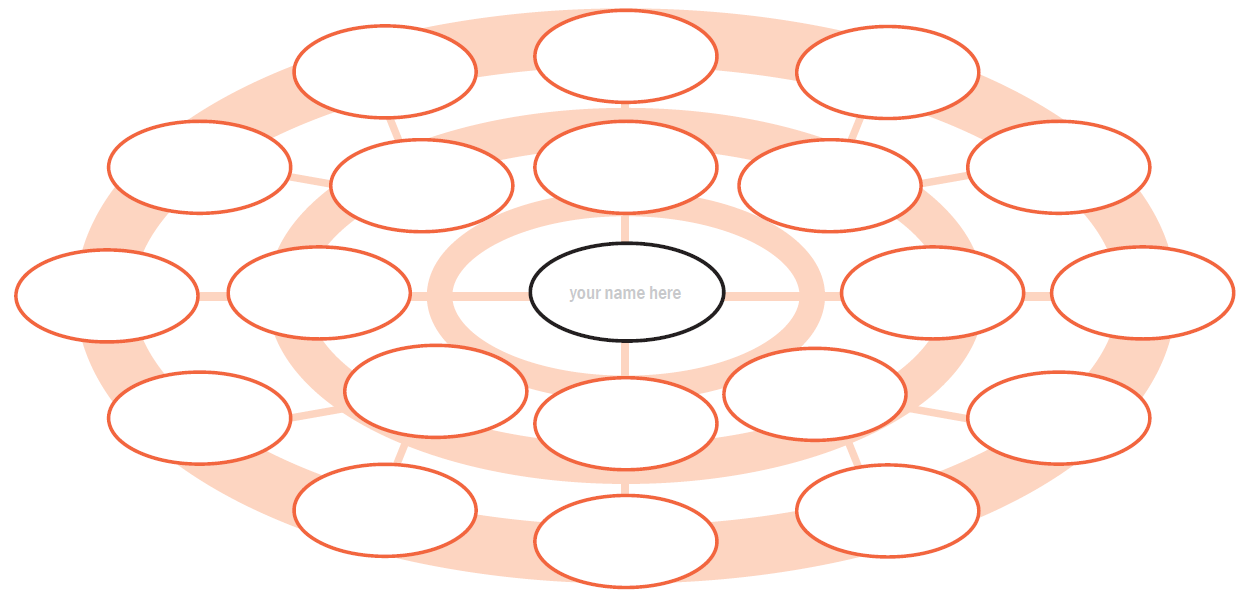
How can specific people in my network support me?
What are your risk factors?
Your emotions can be both your biggest risk factor and your greatest ally. They play an enormous role in your life. If you are very sensitive or sensation seeking by nature, this can be especially true. For many people substance use can be a way of coping with feelings. You may be one of these people. Try filling out the table below and see how using substances might be a way you are dealing with your feelings.
For me, substances are:
-
a reward
-
a thrill
-
an escape
-
helping me feel accepted
-
helping to relieve a craving
-
help me feel relaxed
-
help me feel good/better (high)
-
help me feel creative
-
help me feel comfortable in social situations
-
help me get to sleep
-
help me wake up
-
other
My substance use most often functions as
Fun and healthy activities that can serve the same function for me are (e.g., taking a walk, playing outside with the kids, going for a bike ride, playing tennis with a friend)
Prepare for success
You can prepare for success by making a list of things that might make changing difficult. If you know that it’s going to be tough to resist, for example, smoking a joint after work, plan ahead so you can manage the rough parts with minimal problem.
Think about what might happen when you first cut down or quit, and think about things you can do to reduce the impact. It could be a healthier alternative activity. It could be to call a friend who has cut down or quit using substances, to get support. It could be to yell into or punch a pillow, or say, "you can do it, you can do it" twenty times. It might be to reward yourself for every time you stick to your plan for example, for two weeks. A toonie in a jar for each time you did NOT smoke cannabis after work could get you the hoodie or pair of sandals you wanted.
Use your imagination
People who are successful in business and sports often say they see themselves doing well or winning a championship before they actually do it. That's one of the ways they prepare for a big presentation or sold-out game. You can do the same thing with changes you want to make in your life, whether it is reaching a personal goal, building or repairing a relationship, or changing your drug use.
Imagine what it feels like to be a person who doesn't smoke. Imagine that your clothes no longer smell of smoke, you have more money to spend elsewhere, there is no more hustling to find matches and a place to light up, and no more cravings! Imagine what it would be like to be able to have a drink once a week, and only if you feel like it. You might have enough extra money for those new ear buds!
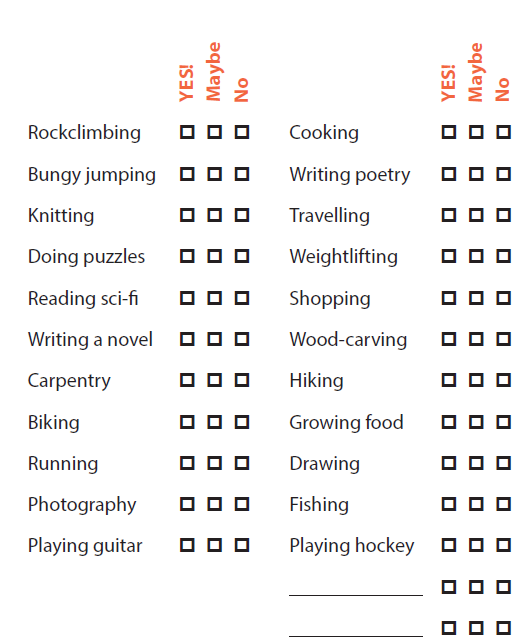
Sometimes it's hard to come up with ideas for new activities that can either help you move toward safer use of a drug, or take its place altogether. If this describes you, try revving up your imagination with the chart at right.
Know what works for you
Some people like to formally declare when they're going to start their "new lifestyle" such as New Year's Day. They believe that by announcing to themselves and others they are locked in to the idea and can't get out of it. Generally, you need to work at it for a while to make it real. Other people need to go one step further and write everything down in an action plan or a letter to themselves, or a contract. Others don't need to do any of the above. They know what to do and need only do it.
You know yourself better than anyone else does, so you know what will work best. If you really don't know, think about other times in your life that you've tried to make changes. How did you do it? Did it work? If "yes," then you have your answer. If "no," try using the tools in this booklet.
Find new friends
Sometimes it's easier to make a new start when you make new friends who don't use substances (or don't use them the same way or amount that you were using them). As well as taking up a hobby to meet new people, you could try connecting with like-minded people on social networking sites or internet forums. Or you could meet new faces in a local church, sport group or other wellness-related organization.
Be positive, change often takes time
As you take steps toward change, you need to stay as positive as possible. Keep in mind that it took time for you to develop your current substance use patterns, and it will likely take some time to develop and fully adjust to a different relationship with substances. Just don't give up on your decision to cut down or quit using a substance, even if you don’t always feel motivated to put the work into being successful. Instead, go for it as long as you can. If you go off your plan one day, don't be too hard on yourself. Think about why it happened, and plan for how you'll handle the same situation if it happens again. Focus on new solutions rather than negative self-talk. That will help you stay on track. Keep looking forward and putting your plan into practice.
Keep personality in its proper place
Your personality is an important factor in why and how you use substances. For instance, if you've been the daredevil, sensation-seeking type since birth, you're more likely to take bigger risks with the type and amount of substance you use than people who have always been on the careful or shy side. Many people have learned to use their risk-taking personality to their advantage by choosing activities or careers such as firefighter, tree faller or highwire circus performer that other people wouldn't ever want to take on!
Shy people can develop substance use problems too. Sometimes shy people use alcohol and other drugs as a way of breaking free of their shyness. They may enjoy the social confidence some drugs give them. Using for this reason can lead to problems—a shy person may start feeling like they must use drugs to be with other people. They also run the risk of sometimes using too much to overcome their social anxieties. Learning to manage risk is important, whether it is part of your personality or the risks involved in using a substance, doing an activity or any type of behaviour.
Are you a risk taker? Are you shy? How would you describe your personality?
Harm reduction strategies
-
350ml can or bottle at 5% alcohol: 1 unit
-
18oz glass at 5% alcohol: 1.5 units
Wine
-
150ml glass at 12% alcohol: 1 unit
-
750ml bottle at 12% alcohol: 5 units
Liquor
-
1.5oz drink at 40% alcohol: 1 unit
-
2oz drink at 40% alcohol: 1.5 units
-
375ml bottle at 40% alcohol: 7.5 units
Lower risk drinking guidelines
|
|
Men & Women |
|
To reduce long-term health risks, never exceed weekly limits. |
2 units |
|
To reduce injury and other harms, never exceed two drinks and adjust your drinking according to the setting. |
2 units |
|
Do not drink when:
The safest option during pregnancy or when planning to become pregnant is to not drink alcohol at all. |
0 units |
Alcohol can harm physical and mental development in young people. Delay drinking until late teens and with parental guidance.
Harm reduction tips
-
eat before or while drinking and alternate with non-alcoholic drinks
-
drink in safe environments
-
no more than 2 units of alcohol in any 3-hour period
Quick tips for reducing harm
-
Buy less so you use less. Buying large amounts of a drug may be cheaper, but you could end up using more than you want to because it's there.
-
Set a time limit before you start. If you choose, for example, to stop drinking at 10:00 p.m., watch the time, remind yourself of your plan, and stick to it. Have some juice or a soft drink ready.
-
Eat a meal before you start using a substance, and avoid snacking on salty foods, especially if you're drinking. You may drink more when you are thirsty.
-
Lower your dosage and frequency. In other words, drink, smoke or inject in smaller amounts—and less often—than you do now. With alcohol, this could mean choosing light beer or other low-alcohol drinks, or alternating drinks with water or soda.
-
Choose the least harmful method of use. Injecting a drug carries more risk than smoking, snorting or swallowing it. If you inject drugs, avoid the neck area. With cannabis, using a vaporizer or smoking a joint (with a rolled- up cardboard filter) is safer than using a bong and some types of pipe.
-
Plan for some drug-free days. The fewer days in a row you use a drug, the better. If you use drugs every day, try cutting back to every other day. Try not using drugs at all for two to three days.
-
Make sure you have other ways to spend your time and energy so you don't end up sitting around and thinking about how you miss getting high.
-
Use at your own speed and don’t feel pressured from others to pick up the pace.
-
Find someone caring and understanding to talk to when you're struggling to stick to your plan for reducing substance use.
-
Read self-help books that feature stories about people who have successfully cut down or quit using a drug.
-
Put condoms in your pocket before you start using a drug, even if you’re not planning to have sex. You might change your mind.
Where to go if you want more help
Sometimes, no matter how hard you try to fix things yourself, you end up having to call in extra help. It is not only okay, it is important to reach out. This doesn't mean giving up control of your mind, body, heart or spirit. You are in charge! You are the one who makes the final decisions about the type and degree of changes you make and when you make them. One way to get help is to talk to a doctor, counsellor, teacher or pastor you trust and feel comfortable confiding in. Another way is to seek help from family and friends. Refer to your support circle to find people you can talk to when you're having a hard time and need help sticking to your plan.
Here are some general resources if you are seeking support to change your substance use:
-
BC 211 connects you to a range of programs and services, including substance use supports, in your community
-
Helplines for Adults in BC. If you need immediate assistance, call 9-1-1, anytime day or night
-
Helplines for Youth in BC. If you or someone you know is crisis, in the Greater Vancouver area you can call: 604-872-3311
-
Free or low-cost counselling services in BC or in the Greater Victoria area
For more information about substance use and related issues:
About the author

The Canadian Institute for Substance Use Research is a member of the BC Partners for Mental Health and Substance Use Information. The institute is dedicated to the study of substance use in support of community-wide efforts aimed at providing all people with access to healthier lives, whether using substances or not. For more, visit www.cisur.ca.