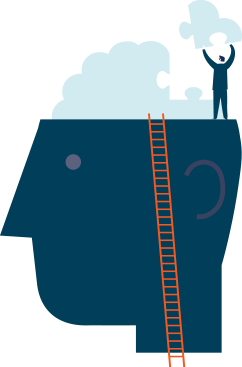
Mood swings. We all have them once in a while. Sometimes we're happy and excited about the world around us. Other times we're sad and the world around us seems overwhelming or dull. We can even experience these very different feelings within the space of a day. But for some people these mood swings can happen to the extreme. If your moods swing from extremely low to extremely high you may have a mental illness called bipolar disorder.
On this Page: |
What is it?
Bipolar disorder is a type of mood disorder. Bipolar disorder used to be called manic depression. It was called manic depression because people with bipolar disorder go through periods of intense depression and other periods where their mood is extremely high. These "high" periods are known as mania. It's important to note that most people with bipolar disorder also have periods where their moods are "normal."
There are different types of bipolar disorder depending on how serious your symptoms are and how long your mood swings last.
-
Bipolar I disorder is when you experience at least one manic episode or mixed episode (see the box on page 3). Most people who have bipolar I disorder also experience episodes of depression. Manic episodes last for at least one week, and depressive episodes for at least two weeks, but both may continue for many months. Bipolar I disorder is the most severe form of the illness.
-
Bipolar II disorder is when you have mostly episodes of depression plus occasional episodes of hypomania. Hypomania (see the box on page 3) is a milder and shorter form of mania that usually lasts just a few days, but it can still impair your functioning. Between episodes, there are usually periods of wellness. The risk of suicide is high for this type of bipolar disorder. It can be hard to tell the difference between hypomania and a "good mood," so bipolar II is also often not recognized as easily as bipolar I.
-
Cyclothymic disorder is when your moods change constantly and quickly from periods of hypomania to depression and you're rarely in a "normal" mood. Cylothymic disorder usually begins early in life and the symptoms are so constant that they are often mistaken as just a part of your personality. But these mood swings can impair your life and create chaos as you may be feeling on top of the world one day and feeling down and depressed the next day. Some people with cyclothymia go on to develop a more severe form of bipolar illness while for others, it continues as a chronic (ongoing) condition.
Who does it affect?
More than 2% of the population will have bipolar disorder at some point in their lives. About 1% of people have experienced bipolar disorder in the past year. Unlike other causes of depression, men and women seem to experience bipolar I in equal numbers. Bipolar II, however, is more likely to affect women. Both types of bipolar affect people of all ages, but tend to appear first in young adulthood, and the risk decreases slightly with age. Bipolar disorder looks quite different in children than it does in adults. Bipolar disorder does seem to run in families. Having a close relative who has bipolar disorder or another mood disorder increases your risk of having bipolar disorder.
What can I do about it?
Some common treatments for bipolar disorder, used on their own or in combination, include:
Medication: There are many different types of effective medication for bipolar disorder, and different kinds work in different ways. Medication can help keep your mood more stable. Mania can make you feel so good that you stop taking your medications. This is very dangerous because symptoms that return after stopping treatment are often much harder to treat properly. Talk to your doctor to find out if medication is right for you and if so, how to use it properly.
Counselling: There are two types of counselling that work best for people with bipolar disorder.
-
Cognitive-behavioural therapy (CBT): A health professional who uses this approach can teach you skills to help change your view of the world around you. They do this by coaching you to break the negative patterns of depression or the destructive patterns of mania including the thoughts and actions that can keep the moods going.
-
Interpersonal therapy (IPT): Often when you are depressed or in mania, your relationships with other people suffer. A health professional who uses IPT can teach you skills to improve how you interact with other people.
Support groups: Support groups, or peer support groups, are meetings where people who are going through similar experiences come together to talk about it. Support groups for people with bipolar disorder and their families can be a great way to realize that you aren’t alone, and you can share your story with others.
Self-help: For milder forms of bipolar disorder, or when moderate or severe symptoms begin to improve with other treatments, there are some things you can do on your own to help keep you feeling better. Regular exercise, eating well, managing stress, spending time with friends and family, spirituality, and monitoring your use of alcohol and other drugs can help keep bipolar disorder from getting worse or coming back. Always making time to get enough sleep is very important, as lack of sleep is one of the most common triggers for mania and depression. Talking to your doctor, asking questions, and feeling in charge of your own health are also very important. Always talk to your doctor about what you’re doing on your own.
Some other terms connected to bipolar disorder
-
Hypomania is a milder form of mania but still more extreme that a regular good mood.
-
Mixed episodes are ones in which you have symptoms of both mania and depression at the same time. For example you might feel excitable and agitated like you do when you're in mania; while also feeling depressed and hopeless. This combination of energy, agitation and depression makes a mixed episode the most dangerous for risk of suicide.
-
Rapid cycling is when a person with bipolar disorder experiences four or more mood swings or episodes in one year.
Where do I go from here?
The best first step is always to talk to your doctor. They can help you decide which, if any of the above treatments would be best for you. If you think you have bipolar disorder, it’s important to see a doctor first to rule out other explanations for your symptoms. If you go to your doctor when you’re depressed, it’s important to also mention if you have other moods as well. This is because some treatments like antidepressants that are very helpful for depression can actually trigger a manic episode if you’ve had one before. So it’s important to give your doctor the full picture of how you’re feeling, even if the mania distresses you less. This will help them prescribe the best treatments to prevent both depression and mania. In addition to talking to your family doctor, check out the resources below for more information on bipolar disorder:
Other helpful resources, available in English only, are:
Mood Disorders Association of BC
Visit www.mdabc.net or call 604-873-0103 (in the Lower Mainland) or 1-855-282-7979 (in the rest of BC) for resources and information on mood disorders. You’ll also find more information on support groups around the province.
Canadian Mental Health Association, BC Division
Visit www.cmha.bc.ca or call 1-800-555-8222 (toll-free in BC) or 604-688-3234 (in Greater Vancouver) for information and community resources on mental health or any mental illness.
BC Schizophrenia Society
Visit www.bcss.org or call 1-888-888-0029 (toll-free in BC) or 604-270-7841 (in Greater Vancouver) for resources and information on psychosis including support groups and services for families of people with serious mental illnesses, including bipolar disorder.
BC Partners for Mental Health and Substance Use Information
Visit www.heretohelp.bc.ca for info sheets and personal stories about (illness). You’ll also find more information, tips and self-tests to help you understand many different mental health problems.
Resources available in many languages:
*For the service below, if English is not your first language, say the name of your preferred language in English to be connected to an interpreter. More than 100 languages are available.
HealthLink BC
Call 811 or visit www.healthlinkbc.ca to access free, non-emergency health information for anyone in your family, including mental health information. Through 811, you can also speak to a registered nurse about symptoms you’re worried about, or talk with a pharmacist about medication questions.
Crisis lines aren’t only for people in crisis. You can call for information on local services or if you just need someone to talk to. If you are in distress, call 310-6789 (do not add 604, 778 or 250 before the number) 24 hours a day to connect to a BC crisis line, without a wait or busy signal. The crisis lines linked in through 310-6789 have received advanced training in mental health issues and services by members of the BC Partners for Mental Health and Substance Use Information.
About the author

The Canadian Mental Health Association promotes the mental health of all and supports the resilience and recovery of people experiencing a mental illness through public education, community-based research, advocacy, and direct services. Visit www.cmha.bc.ca.